The following is an article by Kate Denning, Carolina Public Press. Carolina Public Press is an independent, in-depth and investigative nonprofit news service for North Carolina. You may read it on this publication’s website here.
Due to exhausted funds and concerns about excessive computer-screen time, some North Carolina public and private schools are considering reversing course on one-to-one device access and scaling back on in-class use.
Districts across the country received billions in federal funding during the pandemic, hundreds of millions of which went toward purchasing technology for students to complete work at home in North Carolina. This is also when one-to-one access, where each student is assigned a personal device to be taken home as opposed to classrooms sharing a communal set, became more common.
Krista Glazewski, the executive director of NC State’s Friday Institute for Educational Innovation, said districts are likely facing a costly issue with those pandemic-era devices reaching the end of their life cycles.
Schools nationwide have reported they tend to replace the laptops every three to five years, though Google is making attempts to extend the lifespan of their Chromebooks, the typical device brand that districts have purchased en masse in recent years. Now, six years since the pandemic’s onset, those devices are nearing or well past the time to be replaced — a cost for which many districts are ill-equipped today.
A survey by the NC Department of Public Instruction found that more than half of the individual public and charter school respondents said they had no funding source to replace the laptops once they broke down for good.
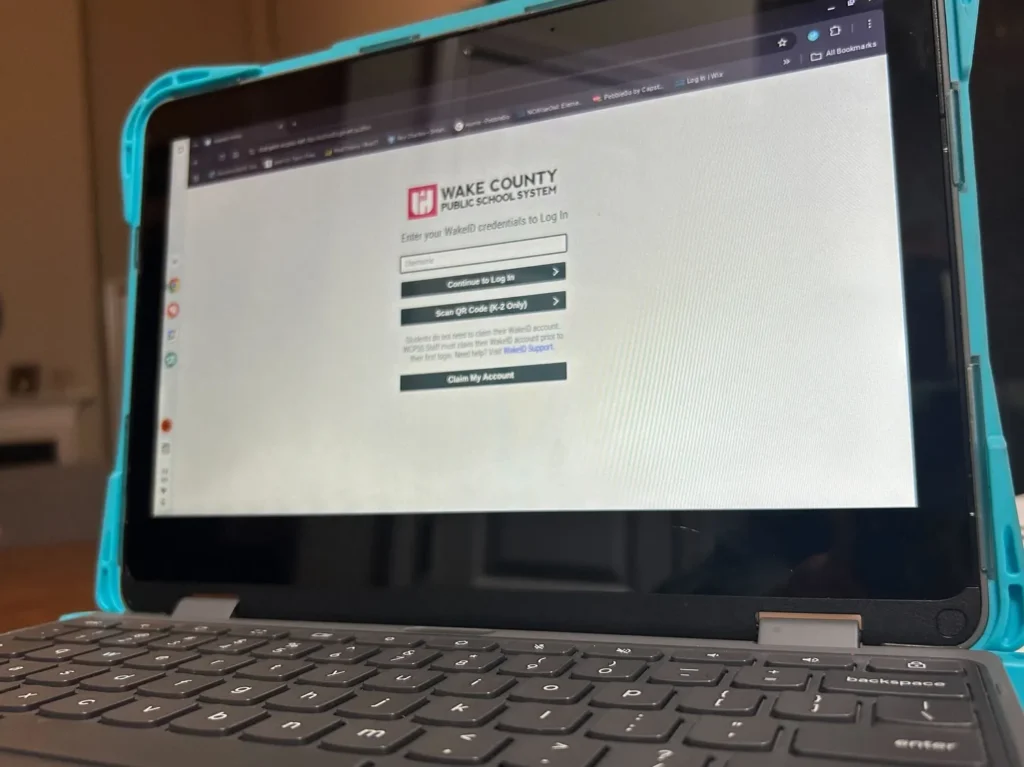
In a 2025 committee meeting, Superintendent Robert Taylor of Wake County Public Schools System said the county’s one-to-one program launched during the pandemic is something Wake County, the largest school district in the state, can no longer afford.
A spokesperson for WCPSS told Carolina Public Press the district is currently in conversation about its anticipated needs over the next several years in areas like technology, security and building renovations. The district’s next step on devices is part of those deliberations, and a decision is to come in the near future, though an exact timeline isn’t set.
The maintenance of the devices is becoming increasingly costly in general, Glazewski said, but the bulk of the burden often falls on smaller, rural districts that don’t have as many resources for repairs and upkeep. Some districts, like Nash County and Durham Public Schools, address that by charging a yearly technology fee to cover minor damage and support overall device sustainability.
Carolinas Academic Leadership Network President Bryce Fiedler said he became aware of the cost burden when WCPSS raised concerns about the laptops’ affordability last year. An often unnoted aspect, Fiedler said, is that public schools are also facing widespread decreasing enrollment in the state, which is directly tied to how much money schools receive.
While the finances are undoubtedly burdensome, Fiedler finds the disadvantages to learning when classrooms rely on the devices to be the most important.
Several studies have yielded clear results that children learn better via paper than digital devices, specifically when it comes to reading, which North Carolina students have struggled with since the pandemic.
“Digital learning is not done as effectively, or at least the brain doesn’t retain information as well as it does through paper-based learning,” Fiedler said.
Possible remedies could look like other districts following the lead of Burke County, Fiedler said. In the summer of 2025, the school board passed a resolution urging teachers to prioritize pen-and-paper learning in hopes of developing more balance between the technological and the traditional.
Less than a year later, parents and educators report improvements in reading comprehension, knowledge retention and homework-related stress, as well as higher test scores overall, though the district noted there are other variables at play in addition to decreased technology use.
Other suggestions by Fiedler besides purely emphasizing pen-and-paper work include focusing on mitigating factors like returning to the computer lab model or confining laptop usage to the classroom rather than students being reliant on an assigned personal device at all times. It’s also critical to consider the ways technology use can impact different age groups and to acknowledge at which points it becomes necessary.
“It should be balanced, strategic, if not completely a pull back from providing laptops for elementary students,” he said.
“We should look into tech-based electives based on student interest as they get into middle school and high school. But the idea that one-to-one has to start as early as elementary school, we’re finding for financial reasons and learning reasons is just not feasible right now.”
Broadly speaking, state lawmakers and school districts are more focused on managing cellphone use in school, Fiedler said. He feels there is more pushback against suggestions that schools scale back on laptop device use simply because “technology” and “learning” have become seemingly synonymous.
“The learning today is so dependent on computers and devices in the schools, so it would be a bigger lift to disentangle schools from relying so heavily on these devices than it would be to pass something like cellphones bans,” he said.
“We would encourage schools not to defer on this too much. There’s not a lot of time to waste.”
Some private schools are already there — not due to funding but rather as a quest for, in the words of Thales Academy, freedom from digital dependency.
Thales is a network of private schools that teaches a classical curriculum at more than 10 campuses across the state, as well as two in Virginia and Tennessee. The school announced in December it was removing “devoted digital devices” from its high school classrooms after it saw enhanced critical thinking, heightened lesson engagement and strengthened human relationships in its junior high students after first scaling back use among those grades.
“While there are certainly benefits to be found in digital devices, the benefits we see for our students when we remove dedicated iPads from the classroom far surpass the benefits of the devices’ utility,” the announcement read.
“… As we have heard overwhelmingly positive feedback from our junior high families and teachers about the change this year, we hope that our high school families and teachers will experience the same next year as we help our students move away from digital dependency toward a foundation more firmly rooted in human interaction and connection and the development of our most powerful human devices.”
This differs greatly from Thales’ approach to technology just a few years ago. A webpage no longer available on the site stated as recently as 2021 the school assigned students an iPad for daily use on and off campus.
“iPads are used throughout the school day, providing an avenue for collaborative and innovative learning. Technology is engrained in the Thales Academy education model, with Apple TVs in every classroom and computer labs outfitted with Apple iMacs to complement the iPad and create a seamless transition between devices for enhanced learning,” the site previously read.
“Students gain competent technical skills throughout their time at Thales Academy and graduate prepared to take on an ever-progressing technology filled world.”
Even as schools pull back on device reliance — whether out of necessity or in a deliberate return to analog practices — that can still look like educational innovation, Glazewski said.
“Such that you can have devices in classrooms and not see much innovation happening, you can have limited devices in classrooms and see a lot of innovation,” she said.
“From my perspective, innovation really happens at the intersection of pedagogy, resources and student engagement. With that in mind, sometimes a resource for innovation is a device, but sometimes it’s the way that a teacher is bringing pedagogy and local resources and field trips and speakers and all the richness of a full classroom experience to bear for students.”
Although technology might not be needed for innovation, and educators have valid concerns about their students being overexposed to screens during and after school, Glazewski does worry about digital divides growing as a result of financial burdens and changes in trends.
As educators weigh different priorities and educational trends change over time, leaders should be aware of how the shifts affect students with various backgrounds.
“We want to give special attention to where we may be inadvertently creating new digital divides in the context,” she said. “I like to really point to, ‘How are decisions being made? Are some students experiencing lower access at higher rates than other students? And if so, what does that look like?’
“Because we want to make sure that there’s equal opportunity for all students to experience the benefits of rich pedagogical, exciting, engaging classrooms without and ensure that all students get to experience that, and that there is not a particular group that is experiencing harm more than others.”
***
Kate Denning is a Carolina Public Press intern whose reporting focuses on education issues. She is a 2025 graduate of North Carolina State University.