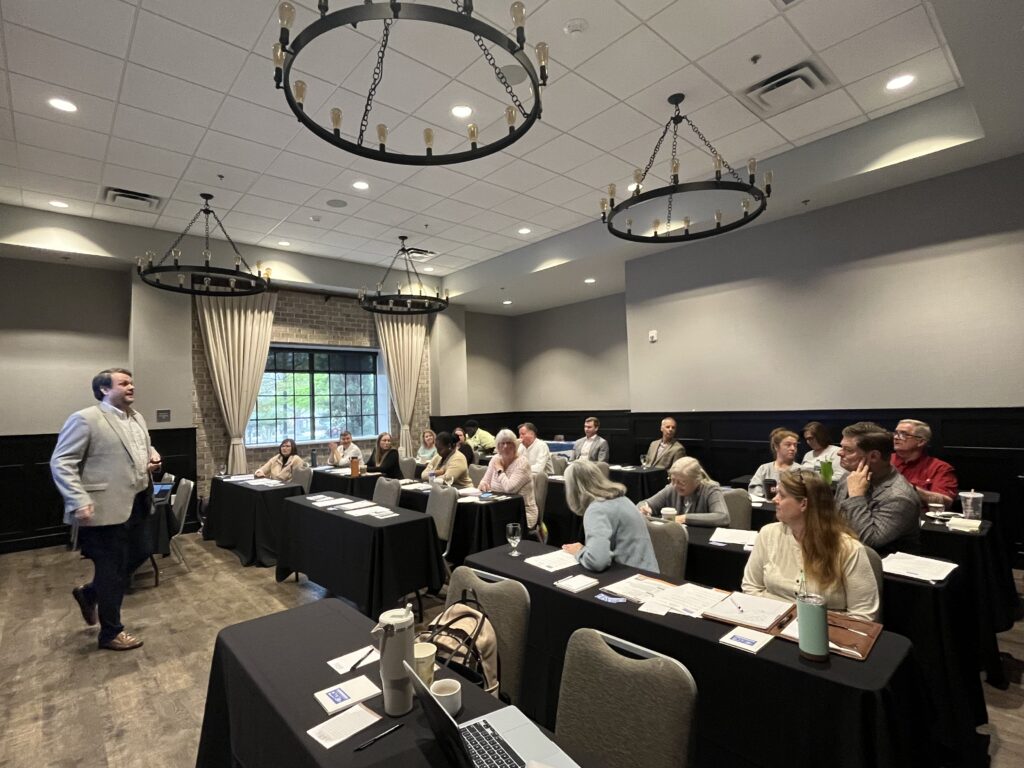
CALN was proud to host its second annual School Board Bootcamp on March 21, delivering high-quality education to board members in a wide range of important areas. Led by specialists in their fields, the day featured six sessions that underscored effective public service: district financial oversight, transparent and ethical decision-making, prioritizing student achievement, and much more.
Cindy Coats, a member of the Berkeley County School Board, kicked off the day with a crash course on board member duties, drawing on her experiences in office to bring real-world insights to the discussion. Her presentation emphasized the “Big Four” of education governance: 1) establishing a strategic vision of excellence for the school district; 2) governing district operations through policy, positions funded, purse strings, parameters, and expectations; 3) hiring the superintendent and holding them accountable; and 4) responsible budget oversight and intentional follow-up.
Alex Sherard of White Story & Hicks, LLC, covered the SC Ethics Reform Act, discussed common conflict-of-scenarios—including how to spot and avoid them—and explained gift reporting rules, among other key topics. Speaking later on FOIA, he stressed the virtues of open and transparent governance, underscoring that public records belong to the people. He presented a handy FOIA compliance checklist, provided local examples, and shared how board members can help facilitate timely and predictable public-records responses.
Dr. Oran Smith of the Palmetto Promise Institute demonstrated the “why” behind effective school board governance in his now-signature presentation, “The State of Student Achievement.” He shared how South Carolina students performed on the most recent state and national standardized tests, highlighting the need to further raise outcomes. Oran also explained the difference between graduate rates and college- and career-readiness scores—a crucial takeaway for all policymakers. South Carolina’s Education Scholarship Trust Fund Program was also briefly discussed.
Later, Aaron Beaulieu of School Operations Specialists gave a comprehensive presentation on responsible school budgeting. Among other takeaways, his session reminded board members that every spending allocation has an impact—and that tradeoffs are inherent in every budget decision and funding priority. This comes as more North Carolina school districts face increasing financial pressures and budget deficits.
Finally, William “Bylaw Bill” Gillmeister closed out the day with an energetic presentation on parliamentary procedure and Robert’s Rules of Order. Bill outlined the fundamental principles of meeting procedure, covering the rules and motions every school board member should know. We concluded with a practice script where attendees acted out a mock meeting and sharpened their procedural skills in real time.
The Bootcamp reflects not only the tremendous level of responsibility school board members have over education, but also the breadth of knowledge and skill development needed to be an effective public servant. CALN is proud to offer these trainings to ensure our elected officials have the tools necessary to represent their communities while advancing student achievement.