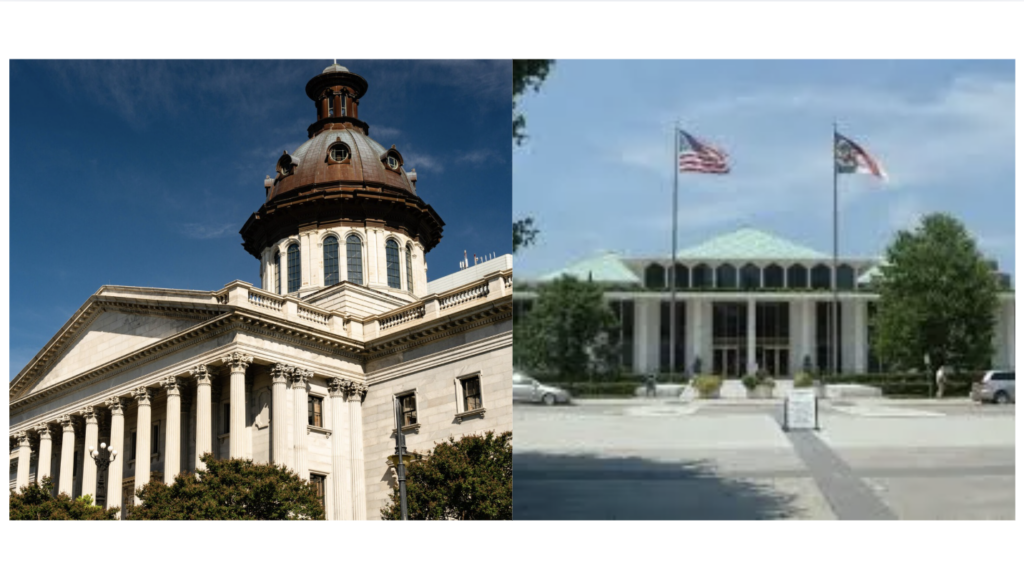
As South Carolina’s legislative sessions nears its close, North Carolina’s short session is just getting underway. This month’s Statehouse Insider gives a status check on key bills in the Palmetto State as lawmakers plan to depart Columbia, while covering early developments from Raleigh.
South Carolina
South Carolina’s regular session ends Thursday, May 14, leaving just two weeks for the General Assembly to finish most legislative business and move bills across the finish line. Here’s the latest on the proposals CALN has been following this year.
Grading floor ban nears finish line
After advancing through the House in March, a bill (H.5073) to safeguard academic integrity and clean up grading practices passed the Senate unanimously with amendments on April 29.
The amendments were relatively minor, keeping the core premise of the bill intact: that schools and districts will be prohibited from requiring teachers to assign students a minimum grade that exceeds their actual performance, otherwise known as “grade floors,” which generally entail a minimum score of 50 or 60 percent. In this section, the Senate version replaced the term “completed” assignments with “required”.
The latest version of the bill also clarifies that charter schools are subject to the same provisions.
Other notable features of the H.5073 include:
- Requiring students to submit all necessary assignments for a course to be eligible for district-approved credit or content recovery, ensuring students demonstrate a genuine effort before makeup opportunities become available
- Prohibiting schools from requiring the results of formative assessments or district-selected benchmark assessments in a student’s course grade, with limited exceptions
- Directing the SC State Board of Education to establish a task force to evaluate potential revisions to the uniform grading policy
A concurrence vote in the House would send the bill to Gov. Henry McMaster’s desk for his signature.
School board training bill before House committee
Update: This bill has been scheduled for a hearing by the full House EPW Committee on Tuesday, May 5, at 11 AM. It passed the full Senate on Feb. 24.
This bill (S.70), which provides for a model code of ethics for school board members and revises a statutory training requirement, is in much better shape following positive changes adopted by lawmakers during the Senate process.
Under this amended version, the state Department of Education must adopt a required training program for board members following their election/re-election. The training may be provided by the department or other entities it designates. A trustee who fails to receive this training within six months of taking office shall have his name submitted to the governor for removal (however, they would first be notified that they are out of compliance and given a reasonable window to satisfy their training before removal a proceeding occurs.)
You can read about the bill in full in our previous update; however, some details, including the district designation component, have been modified or removed following the Senate’s amendments.
General Assembly passes Student Physical Privacy Act
Another key bill covered by CALN received final passage in the House on April 15. It awaits ratification and should soon be sent to Gov. Henry McMaster’s desk for signing.
The “Student Physical Privacy Act” would codify existing state budget protections that require public schools to designate multi-use restrooms, changing facilities, and sleeping quarters by biological sex, while extending similar requirements to public colleges and universities. You can read our more detailed bill overview in last month’s Insider.
Before passage, it received several minor amendments, including a change that gives any individual—not just a student or school employee—a private cause of action against a school that violates this section.
No movement on Parental Rights Act
Despite early momentum and receiving a near-unanimous vote in the House this February, the Parental Rights Act has seemingly stalled and shows slim odds of passing this year without a last-minute rescue. It has not been scheduled for a committee hearing in the Senate as of writing.
The bill (H.4757) affirms a series of fundamental parents’ rights in state law, such as the right to direct the education of their children, make and consent to their physical and mental healthcare decisions, and participate in parent-teacher or school organizations offered by a district. That includes the right of parents to inspect all curriculum and teacher-training materials for any class their child is enrolled in, occurring either in person or online.
If passed, local school boards would need to adopt a parents’ rights policy that aligns with State Board of Education (SBE) guidelines. Parents may file a complaint to address violations, which may be appealed to SBE. H.4757 also establishes a private cause of action in the event all previous options have been exhausted, subject to various criteria.
Its passage would strengthen parental rights in education and provide substantive recourse when violations occur. Should it fail to advance this session, it will need to be re-filed in 2027.
North Carolina
North Carolina’s short session kicked off on Tuesday, Apr. 21. While short sessions typically see less legislative activity and fewer bills passed, the question on everyone’s mind is: Where is the new state budget? It remains the only state in the nation without one.
In practice, that means spending levels from the previous fiscal year generally remain the same, barring minor stopgap appropriations. School funding—and with it, teacher pay—therefore remains of particular focus and concern for K-12 officials and board members. Unfortunately, recent reporting indicates that a budget deal is still not in sight.
We’ll continue providing updates on budget developments as they occur. In the meantime, here are several education-related bills vetoed by Gov. Josh Stein last year that await potential override votes. Whether they’ll be taken up and passed remains to be seen:
- HB87 – Educational Choice for Children Act
- HB171 – Equality in State Agencies/Prohibition on Diversity, Equity, and Inclusion (DEI)
- SB227 – Eliminating “Diversity, Equity, and Inclusion (DEI)” in Public Education
- SB558 – Eliminating “Diversity, Equity, and Inclusion (DEI)” in Public Higher Education
Teacher licensure overhaul passes Senate committee
In other news, a bill to remove or loosen barriers in the teacher licensure pipeline was advanced by the Senate Education/Higher Education Committee on April 29, the Carolina Journal reports. According to the outlet, SB840 “repeals the requirement that prospective teachers pass the Praxis Core Academic Skills for Educators before admission to an Educator Preparation Program. The Praxis Core is an assessment of basic skills in reading, writing, and math,” in addition to other changes.