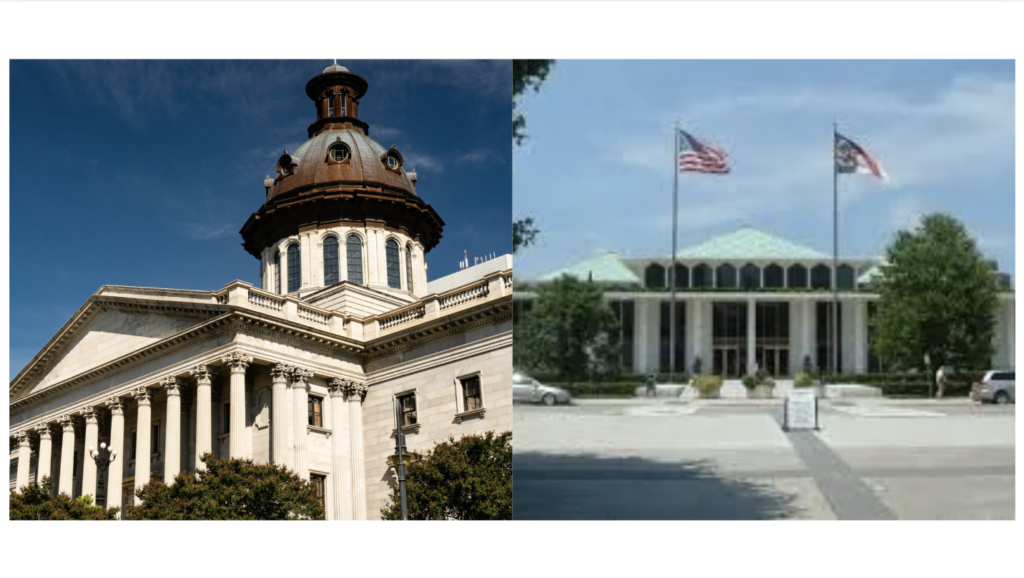
South Carolina’s legislative session has officially come to a close, and North Carolina’s short session is fully underway. This month’s Statehouse Insider gives a final look at key bills in the Palmetto State, while covering new developments from Raleigh.
South Carolina
South Carolina’s regular session ended on Thursday, May 14. Here’s the latest on the proposals CALN has been following this year.
Grade floor ban becomes law
After advancing through the House in March and passing the Senate unanimously in April, this bill (H.5073) to enhance academic integrity and improve grading practices was signed by the governor on May 18.
The core premise of the bill remained intact throughout the process: that schools and school districts will be prohibited from requiring teachers to assign students a minimum grade that exceeds their actual performance, otherwise known as “grade floors,” which generally entail a minimum score of 50 or 60 percent.
The latest version of the bill also clarifies that charter schools are subject to the same provisions.
Other notable features of the H.5073 include:
- Requiring students to submit all necessary assignments for a course to be eligible for district-approved credit or content recovery, ensuring students demonstrate a genuine effort before makeup opportunities become available
- Prohibiting schools from requiring the results of formative assessments or district-selected benchmark assessments in a student’s course grade, with limited exceptions
- Directing the SC State Board of Education to establish a task force to evaluate potential revisions to the uniform grading policy
Note: a school district that violates these provisions will have 10 percent of its state funding withheld.
To gain full insight on this bill update, check out our Press Release which gained immediate traction nationwide and internationally!
School board training bill signed by the governor
Legislation (S.70) to revise training requirements for school board members and establish a model code of ethics was signed by the governor on May 18.
Notable changes to training include:
- Clarifying that trustees must receive training after every subsequent re-election/re-appointment and that such training must occur within nine months of taking office (up from the current one-year window)
- Adding “nepotism” and “conflicts of interest” as required training topics
- Directing the Department of Education or its “designee(s)” to provide the training program, replacing the current process by which the State Board of Education determines training providers. This will ideally result in trustees and full boards having greater flexibility in choosing where to receive the training.
- Trustees who do not complete this training within the specified timeframe will be subject to removal from office, following a caution letter issued by the State Board of Education (SBE)
New ethics provisions under S.70 include:
- Requiring local school boards to adopt a model code of ethics consistent with a model policy established by the SBE
- Penalties for violations of a model ethics code (to be determined by SBE) were removed in the final version of the bill
Student Physical Privacy Act is codified
The “Student Physical Privacy Act,” another key bill covered by this session, was signed into law on May 15.
The legislation (H.4756) codifies existing state budget protections that require public schools to designate multi-use restrooms, changing facilities, and sleeping quarters by biological sex, while extending similar requirements to public colleges and universities. You can read our more detailed bill overview in our previous Insider.
Before passage, it received several minor amendments, including a change that gives any individual—not just a student or school employee—a private cause of action against a school that violates this section.
Moreover, a district that violates this article will have 25 percent of its school operations funding withheld until it is found to be compliant.
Parental Rights Act falls short
Despite early momentum and receiving a near-unanimous vote in the House this February, the Parental Rights Act (H.4757) was not passed this session.
The bill would have affirmed a series of fundamental parents’ rights in state law, such as the right to direct the education of their children, make and consent to their physical and mental healthcare decisions, and participate in parent-teacher or school organizations offered by a district. That includes the right of parents to inspect all curriculum and teacher-training materials for any class their child is enrolled in, occurring either in person or online.
The bill will need to be re-filed in 2027.
North Carolina
North Carolina’s short session kicked off on Tuesday, Apr. 21. While short sessions typically see less legislative activity and fewer bills passed, there are a few proposals to keep an eye on. Most importantly, lawmakers earlier this month announced a budget framework that could be taken up the week of June 15—signaling the end of a months-long standoff over spending levels that’s left North Carolina without a new budget.
Early budget details
The Carolina Journal reports the budget agreement includes an average 8 percent raise for teachers, with bonuses ranging from $500 to $1,000. House Speaker Destin Hall also indicates the plan maintains funding for the Opportunity Scholarship program.
Additionally, the proposed deal features a state constitutional amendment to establish a property tax levy limit, which voters would need to approve should it pass the General Assembly.
Teacher licensure overhaul passes Senate committee
In other news, a bill to remove or loosen barriers in the teacher licensure pipeline was advanced by the Senate Education/Higher Education Committee on April 29, the Carolina Journal reports. According to the outlet, SB840 “repeals the requirement that prospective teachers pass the Praxis Core Academic Skills for Educators before admission to an Educator Preparation Program. The Praxis Core is an assessment of basic skills in reading, writing, and math,” in addition to other changes.
Foundational Mathematics Act filed this year
S1044, a bill which aims to improve student proficiency in mathematics and appropriate funds for delivering high-quality instruction and support, was reported favorable by the Senate Education/Higher Education Committee and re-referred to Committee on Appropriations/Base Budget on May 13.
Aspects of the bill include:
- Establishing criteria for delivering evidence-based math instruction to K-8 students
- Requiring screening for students at least three times per year with assessment criteria. Professional development shall be provided to teachers to ensure that assessment data is used meaningfully.
- Students who are not proficient at grade-level math based on early screening in the school year must be provided with intervention and remediation services, and their parents shall be notified.
- The Office of Learning Research, in consultation with the Department of Public Instruction, mathematics researchers, and other relevant stakeholders, must conduct an initial review of high-level instructional materials, as well as a long-term review based on models used in other states.
Finally, here are several other bills CALN is following this short session:
- S1044 (Foundational Mathematics Act): Reported favorable by the Senate Education/Higher Education Committee and re-referred to Committee on Appropriations/Base Budget on 5/13/26
- H488 (Modify School Performance Grades): Filed 3/24/25 and referred to the House Committee on Education
- H573 & S204 (Remove Testing Requirement for Teacher Licensing): Filed 3/27/25 & 2/27/25 respectively, and referred to their respective education committees
- H846 (Teacher Retention and Recruitment): Filed 4/9/25 and referred to the House Committee on Education
- H878 (Increased Academic Transparency): Filed 4/9/25 and referred to the House Committee on Education