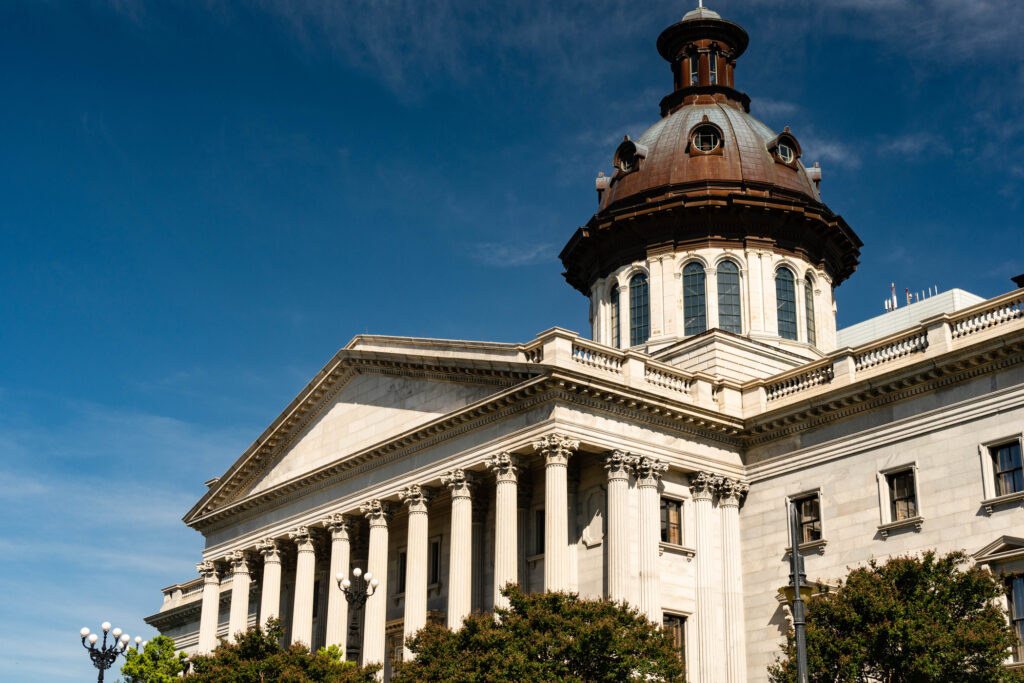
This is the first edition of the Statehouse Insider, a new initiative of Carolinas Academic Leadership Network covering K-12 legislative updates, state budget developments, and timely news. This week’s coverage looks at the first week of South Carolina’s 2026 legislative session. North Carolina news will be included in later updates when its General Assembly convenes in February.
SC Department of Education budget requests
S.C. Superintendent of Education Ellen Weaver presented Wednesday morning to a House appropriations subcommittee on the Department of Education’s FY2026-27 budget requests and strategic plan.
Ms. Weaver reaffirmed South Carolina’s statewide educational goal: ensuring that at least 75% of students are performing at or above grade level by 2030. Efforts to achieve this will include a multi-year push to accelerate outcomes in math and literacy, as well as elevating the quality and long-term effectiveness of “school, district, and board leadership,” according to the department’s strategic plan.
The second point reinforces the critical role our local school boards play in raising achievement, aligning with CALN’s mission to strengthen governance as a lever for better outcomes.
During her remarks, Ms. Weaver applauded Spartanburg School District 4 and Superintendent Dr. Aaron Fulmer for having a college-and-career-ready rate that matches its graduation rate, demonstrating that students are graduating with the expected skills to succeed after school.
Budget request highlights
- Summer reading camps – $30M (recurring): Expand targeted summer reading interventions to first and second graders (as well as third graders) as required by recent legislation.
- High-quality instructional materials – $50M (non-recurring) and $20M (recurring): In preparation for an upcoming statewide social studies and civics adoption
- Education Scholarship Trust Fund – $61M (recurring): Funds year three of the ESTF program to serve a recommended 20,000 students
- Bus lease/purchase program – $40M (recurring): Maintains the state-mandated 15-year bus replacement cycle
Teacher pay and support
The department’s requests include a base pay increase as well as funding for performance-based compensation tied to student outcomes and teacher impact.
- Teacher salaries – $150M (recurring): Would raise starting pay from $48,500 to $50,500 and increase every cell by $2,000. For reference, starting teacher pay is up 52% since 2019, highlighting a concerted, multi-year effort to increase regional competitiveness.
- Strategic compensation pilot – $5M (non-recurring): Supporting additional compensation opportunities tied to performance.
- Strategic teacher career ladder pilot – $1.4M (recurring)
- Learning management system – $8.2M (recurring): Time-saving initiative that integrates instructional content, assessment data, and other information.
Ms. Weaver also highlighted the Palmetto Civics Project, an initiative of the department centered on “the institutions and individuals that uphold our civic life” in celebration of SC250. We encourage schools to take advantage of these free, standards-aligned resources as part of their social studies and history instruction.
Governor’s executive budget
S.C. Gov. Henry McMaster also unveiled his 2026-27 Executive Budget this week, outlining his funding recommendations for the next fiscal year. While funding priorities are ultimately set by the General Assembly, these proposals have increasingly helped to shape and influence the final state budget in recent years. K-12 highlights include:
- $150M to increase base teacher pay from $48,500 to $50,500, aligning with the department’s request.
- A similar $61.4M request to fund ESTF scholarships for 20,000 students. This would also slightly increase the scholarship amount to $7,634.
- $9.9M in EIA surplus revenues to expand full-day 4K in private centers that have available spots for qualifying families.
- $8.7M to provide free breakfast for students, regardless of household income.
- Continued funding levels ($56.2M) to maintain a certified SRO in every school.
State agency budget hearings will continue through the month and eventually reach the Senate, where officials will make similar presentations before various Finance subcommittees. These hearings will inform initial legislative appropriations drafts, ultimately shaping the full House and Senate budget proposals this spring.